Saturday, March 3, 2012

Brian Rafalski

It's been nearly twenty years since Christian Laettner's game-winning buzzer beater in the semi-finals of the NCAA Tournament against Kentucky shocked the nation. No doubt that shot will be shown countless times in the next month to the point of extreme annoyance. But it wasn't just that shot that made the Duke-Kentucky game so incredible; the 64 minutes and 57.9 seconds leading up to helped make it one of the greatest games in college basketball. In the end, though, what 98% of people remember is Christian Laettner's shot sending the Duke Blue Devils to the Final Four. Not Kentucky fans, though. Those fans remember it for something, or, to be more precise, a few someones, entirely different.

Richie Farmer. Deron Feldhaus. John Pelphrey. Sean Woods. The four seniors on that Kentucky team had been through a lot. After their freshmen season, their head coach, Eddie Sutton, was forced to resign following an NCAA investigation of several violations, including alleged cheating of a former player on his college admission exams and cash payments to the father of another player. The investigation was carried out throughout their freshmen season (1988-1989) which, due to several key losses, was Kentucky's first losing season since 1927. A ban was placed on the school that prevented them from playing any televised games during the next season or from any post-season play during the next two. Most of the Kentucky team of 1989 left when Sutton did. Those four didn't. The four soon-to-be-sophomores stayed with Kentucky and entered uncharted territory - no coach, no team, and, it appeared, no future. In the only NCAA Tournament they were able to shine in, they led the Wildcats in a remarkable run to one of the greatest games of all time. Following the game, the university retired their jerseys while they were still in school. They were the Unforgettables. 

Flash forward to 2012. Kentucky has six freshmen, three sophomores, two juniors, and two seniors. Last year they had seven freshmen - four left to play professional basketball. At the bare minimum this year, one freshmen (Anthony Davis) is expected to leave this year as well. But it's ok - Head Coach John Calipari already has two five star, top 20 recruits ready to replace him. 

Kentucky has entirely transformed itself in the last twenty years. They've always been a national powerhouse, but under John Calipari they are doing something that's never been done before in college basketball - they've become a "One-and-Done" factory. Five-star recruits come in for their mandatory one year of college basketball, play for Calipari, leave for the NBA, and are replaced. Lather, rinse, repeat. And who can blame Calipari? His team has lost one game this season, they're ranked #1 in the country, they'll get the #1 overall seed on the NCAA Tournament, and most analysts predict they'll win the NCAA Tournament (not that that really matters - last year, a grand total of two analysts predicted that eventual champs UCONN even would reach the Final Four). Calipari is taking good advantage of a broken system. 

In 2006, the NBA increased the age limit of the draft from 18 to 19 and required U.S. players to be one year removed from high school before playing in the NBA. This means that stars like Derrick Rose, Kyrie Erving, and John Wall are forced to miss a year of basketball or, more likely, take their talents to a school for one year before moving onto the NBA. This rule benefits no one and harms everyone. There are numerous arguments that could be made against the rule:

1) It makes the term "student-athlete" a complete joke. One-and-done players come into college knowing they'll be leaving at the end of the year. That requires them to make good grades until the end of basketball season. They don't need to challenge themselves. They don't have to take their education seriously. A valuable privilege that should be graciously accepted and taken advantage of becomes an obligation, a chore, a mere stepping stone on the way to the NBA.

2) It puts the athlete in an unfortunate situation. Student athletes will tell you that, while the prospect of going to the NBA for the love the game is appealing, the idea of getting paid makes it even better. For some that's a bonus; for some it's a necessity. A lot of student athletes don't come from upper class families; going to the NBA is a way to provide their families with the kind of financial support that that they've never had before. At the same time, an extra year of playing basketball is an extra year of risking injury and preventing that NBA dream from ever coming true. Take Kyrie Irving: he was a one-and-done for Duke in 2011. While playing at Duke, he broke his toe. Fortunately for him, the toe healed and he was still drafted #1 overall by the Cleveland Cavaliers but he is an excellent example of why the age limit is dangerous for players: if Kyrie Irving had broken more than his toe, his entire career would have been on the line or maybe even over before it started so he could...play basketball at college for his mandatory year off before going pro? 

3) It puts coaches in an unfortunate situation. As if recruiting wasn't difficult enough, the age rule adds an extra factor to the equation. Coaches now have to figure how long they'll have a player for and how they can recruit around that position and that player. 

4) Why is the rule even there? Some of the best players in NBA history - Lebron James, Kobe Bryant, Kevin Garnett, Dwight Howard - came straight from high school.

5) It harms the university and this is where we come back to Kentucky. The Unforgettables of 1992 were something special. They stayed with Kentucky because they loved Kentucky. They could have transferred; they likely would have been successful wherever they went. And, to be honest, they weren't high priority recruits for Kentucky; they were kind of the runts of the litter. But they loved that school and they couldn't imagine playing anywhere else. They stuck with Kentucky not because it was great (and it wasn't great, at that moment) but because they wanted to make it great again. The one-and-done rule makes the university a stepping stone, an obstacle to overcome before the real work begins. There's no undying loyalty to the school, to the fans, to the history of the program. It's disrespectful and diminishes the work that past players and coaches have done. 

1989. Four Kentucky freshmen remain with their team despite the uncertainty of the program's future because they love the Wildcats. 1992. They're honored as the Unforgettables, the heart and soul that brought the Wildcats back to national relevance.

April 2011. The Kentucky Wildcats lose in the Final Four to UCONN. June 2011. Four Kentucky freshmen are drafted in the first round. November 2011. Six new freshmen enter Kentucky. Begin again.

2012. A lot can change in twenty years. And a lot can be changed going forward. Here's what I think should be done. It goes without saying that the age rule should be abolished. Players should be able to chose whether to go pro straight out of high school or to go to college. If they chose to go to college, though, make it a three year commitment, minimum. This ensures that players who actually want to be student athletes have that opportunity and those who don't are forced to go to school; only the athletes who care would come and isn't that the kind of students colleges want? Coaches wouldn't have to plan every recruiting class around guess work of how long a player will stay. Players might put more thought into the school they're going to because they'd be there longer. The players that want/need to go to the NBA can do so without being penalized with an extra year of waiting and warding off injury. And the NBA gets great players a year sooner than they normally would. Everyone wins. 

Brian Rafalski is an American hockey defensive player with jersey #28. He played college hockey for the University of Wisconsin but was not immediately sought after by the NHL. Instead, he traveled overseas and played in Sweden and Finland, and became the first non-Finnish player to be voted best player by his peers. In 1999, he was declared by Sporting News to be the best hockey player not playing in the NHL. That same year, he was signed by the New Jersey Devils as a free agent. He played with the Devils until 2007 when he was signed by the Detroit Red Wings. In 2011, he retired due to knee and back injuries. During his 11 NHL seasons, he qualified for the post season every year. He played in five Stanley Cups and won three. 

Thank you for your time.
The Sports Nerd

Thursday, February 9, 2012

Brandon Jacobs

#1: The Syracuse Orange


I'm going to go out on a limb here: come March, Syracuse will not make the Sweet Sixteen. Of the current number 1 seeds projected by Lunardi 2 days ago, (Missouri, Ohio State, and Kentucky being the other three), Syracuse is by far the weakest, despite being the overall #1 seed. I'm not a big fan of Ken Pomeroy's basketball rankings (#1 reason why: Michigan State, 18-5, strength of schedule: 11, is ranked one below Wisconsin, 18-6, SOS: 31, whom the Spartans defeated earlier this season. I have other reasons, but that one best exemplifies my opinion) but I'm going to be citing him a lot in this entry because his rankings are easy to compare. Syracuse is ranked #6 by Pomeroy (below both MSU and Wisconsin); they have a strength of schedule of 55 and here's why: they have played 3 ranked teams this entire season. Ohio State, ranked below Syracuse in the AP poll but above them in Pomeroy, has played 7. Michigan State has played 7. Wisconsin has played 6. Northwestern, who I've argued before would make the NCAA tournament if they were in a different conference, has played 5. They have a higher strength of schedule at this point in the season than the #2 team in the nation. It's easy to 24-1 when you play below the best of your abilities.

Syracuse's games against ranked opponents so far this season have been against Florida, Marquette, and Georgetown and they've won them all. Against unranked opponents, they've won by an average of 19.5 points; against ranked opponents, they've won by an average of 4.6. When they've played against formidable opponents, Syracuse has struggled. This is part of the reason that I think they'll struggle in March. Everyone will be good. Syracuse has two games remaining against ranked opponents, both of which are against Louisville. It's a shame that Marquette won't get the chance to play Syracuse in Milwaukee this season; if they did, I think they would win. With any luck, they'll get that opportunity during the Big East Tournament instead.

#2: The Officials


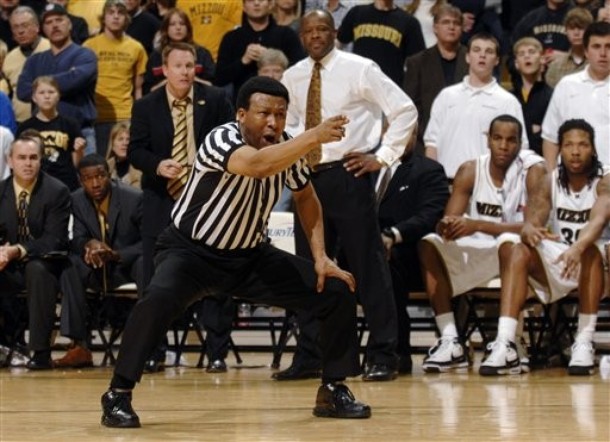
I'm not the only person who, after watching a game end with an outcome different from what I want, would be happy to blame the officiating. Most of the time, that's a coping mechanism: it's reassuring to blame your team's poor performance on that guy on the sidelines with the ridiculous facial expressions and over-the-top gestures that the cameras show as much as the players. Sometimes it's accurate. And when it's accurate, we're left with this question: to what extent can we place blame on the referees?

On January 28, with 26.3 seconds to go at home against West Virginia, the Orange (Oranges?) found themselves up by two with the ball in the hands of the Mountaineers. After an airball, Deniz Kilicli of West Virginia grabbed the rebound and put the ball back up with 11 seconds left only to have it blocked by Syracuse's Baye Kieta and, after a Syracuse miss and a failed desperation three by the Mountaineers, Syracuse won. Here's the thing: it wasn't a block. It was goaltending.

This brings us back to the question of how much blame can be placed on the officials or, to phrase it differently, how much responsibility should the officials take for blown calls? We have no idea what would have happened in the remaining 11 seconds of that game. Perhaps the shot would have gone in and Syracuse would have hit a buzzer beater at the end to win it anyway. The blame can't be placed squarely on the officials. West Virginia could have done more to guarantee that the game didn't come down to the final possession: they could have shot more than 40.7%; they could have held Syracuse below 46%; they could have made one of the 12 threes they missed, Kilicli could have gone more than 1-5 from the free throw line.

At the same time, maybe the game would have gone to overtime and West Virginia would have gone on a 13-4 run to win. As coach Bob Huggins said afterwards in reference to the goaltending call, "Do I think it was? No. I know it was. I saw the replay. It's hard. You've got 30 seconds and you're trying to get the refocused and they're all thinking about other things."Once a chance like that is taken away, through no fault of your own, it's hard to concentrate on anything but how unfair that is. Sure, they had a chance after the game but that was the momentum changer, the moment where they could say, "Even when I do the right thing, it goes against me." At the very least, this should have been acknowledged. Someone should have come forward and apologized. It's been done before after blown calls and this was undoubtedly a situation where one would be applicable. No such apology was given.

After mistakes like these, defenders will rush to the sides of the referees and say, "No one's perfect" or "That's a tough call" and they're right. But making those tough calls, and making them correctly, are their jobs. If the officials can't make the right call at the end of a close game, why are they still officials?

#3: The Iowa State Cyclones


And now for something completely different! I'm kidding; there is a connection between all of this, I swear. The Cyclones are currently 17-7, 7-4 in the Big 12. They made national news recently after defeating #5 Kansas, but I've been watching them for reasons entirely unrelated for some time now.

42% of Iowa State's playing roster are transfer players. That's 5 of their 12. What's more, 3 of those 5 are from the Big Ten - Chris Allen from Michigan State, Chris Babb from Penn State, and Royce White from Minnesota - and they have at least one more Michigan State transfer (Korie Lucious) redshirting to play for them next season. Head Coach Fred Coiberg has one of the most unique recruiting strategies in the country - take a hodge-podge of talented players who didn't quite fit in with their past schools and put them together in the hopes of making a talented basketball team. It's working.

Individually, the players are flourishing. A rough freshmen year at Minnesota, which involved clashes with head coach Tubby Smith as well as legal problems, led to White leaving the team before the season started. Kentucky coach John Calipari offered White a spot on the squad - not surprising, as White was Mr. Minnesota and one of 20 players chosen to play in the 2009 Jordan Brand Classic - and White was prepared to accept until he thought about the plane ride it would take to get there. White's fear of flying, coupled with an anxiety disorder that began at age 10 after watching his best friend nearly die of a heart condition, caused him to cancel his flight and end his opportunity to play with the Wildcats. He ended up in the middle of a cornfield in Iowa, where he's the team's leader in scoring, rebounding, and assists per game. His anxiety problems still wake him 4-5 times a night and leave him questioning simple decisions for hours, but he's gaining control - with under 2 minutes left in the Kansas game, following a night that involved waking from a nightmare about missing a free throw and running to the gym in the early hours of the morning for practice, White hit 2 critical free throws to give the Cyclones a 5 point lead.

White's is just one of the transfers success stories. Following an unexplained dismissal from the Spartans, Chris Allen trails only White in points and assists per game. The 3rd highest scorer is Scott Christopherson, a transfer from Marquette and the 4th is Chris Babb from Penn State. 4 of the 5 starters from Iowa State are transfers.

Iowa State is 17-7, 7-4 in the Big 12. They've played 4 ranked teams thus far (more than Syracuse) and beaten one (Kansas); they still have 3 more left to play. They're ranked 37 by Pomeroy with a SOS of 38 (compared to Syracuse's 55). They haven't lost by more than 10 points this season (vs Iowa and Michigan) and their worst loss of the season, at Drake, came by 9 in the first weekend of the season. They've split games this season with Texas and Oklahoma St and defeated Kansas St in their first matchup; these are the other 3 Big 12 bubble teams.

Here's my other prediction for March: Iowa State will make the Sweet Sixteen. Here's why: 1) they don't do anything great, but they do everything well. They shoot 45% from the field and they rank in the top hundred for assists, points, and rebounds per game. 2) They've played a challenging schedule. Not only do they face ranked teams in their conference, but they willingly challenged themselves in the non-conference schedule as well. They haven't won many of these games, but they've been competitive in all of them. They're prepared for anyone. 3) For whatever reason, this team has chemistry. Maybe it's because they live in the middle of no where and have nothing else to do besides spend time together or maybe it's because many of them have been redshirted for a year before they started playing so they had time to prepare or maybe it's because they appreciate the importance of second chances and are trying to make the most of theirs; whatever it is, it's working. The team plays well, the play competitively, and they play together and that's what they need to go on a run in March.

#4: The Grand Conclusion


Syracuse and Iowa State are about as opposite as they can be. Syracuse is overrated, Iowa State is underrated. Syracuse is ranked nationally despite only playing 3 ranked teams while Iowa State is just beginning to receive national recognition for defeating one of the 4 ranked teams they've played so far. Syracuse is better, but Iowa State is better prepared. At this moment, Joe Lunardi currently has Syracuse as the #1 seed and Iowa State the #9 seed in the east - meaning that, right now, they are projected to meet up in the second round to determine who goes to the Sweet Sixteen. My prediction stands. Iowa State goes to the Sweet Sixteen. Syracuse doesn't. Unless the officials have something to say about it.

#27


Brandon Jacobs wears jersey #27 for the New York Giants, Super Bowl XLVI Champs. He's a 6-4 running back from Southern Illinois University. He played in 14 games this season and started 6, but the Super Bowl was not one of these 14. That didn't stop him from getting some attention from the media, though. After Tom Brady's wife, Giselle Bundchen, said, "My husband cannot ... throw the ball and catch the ball at the same time. I can't believe they dropped the ball so many times", Jacobs jumped to the defense of his opposition and told Bundchen "to be cute and shut up". He apologized for the latter part of the comment...unnecessarily, in my opinion.

Bon voyage!
The Sports Nerd

Monday, January 23, 2012

Joe Paterno

If you're anything like me, the announcement of legendary Penn State coach Joe Paterno's death was met with mixed emotions when you turned on Sportscenter on January 22, 2012. First, I was a bit stunned (though I would have been more stunned had CBS not inaccurately reported his death the night beforehand). Yes, Joe Paterno was old and sick, but Joe Paterno has been around for forever. There were times when, following a press conference, I would find myself thinking, "How is this man still standing, let alone coaching?". That's not meant to be funny or rude; it's just the truth. Joe Paterno was old, but he was omnipresent in college football, especially in the Big Ten. Everything changed on November 5, 2011, when sexual abuse charges were first brought up against Paterno's former assistant coach, Jerry Sandusky. The number of people involved in the scandal eventually increased to encompass Paterno himself, leading to his firing on November 9, just four days after the scandal was revealed. Less than three months later, and before his testimony could be used against Sandusky, he was dead, leaving the sports world reeling over how to remember one of the greatest college football coaches of all time, and also one of the most disappointing.

The Kubler-Ross model was first proposed by Elisabeth Kubler-Ross in her 1969 book, On Death and Dying. She based her model off research and the experience of over 500 dying patients that she interviewed. The model she proposed is better known as The Five Stages of Grief.

Stage 1: Denial
Nobody wants to think ill of the dead. It would be easy to concentrate solely on Joe Paterno's accomplishments because there are so many of them. The 2011 season was Paterno's 62nd year with Penn State, his 43rd as head coach, making him the longest lasting head coach at a single school in history. He ended his career with 409 victories and 24 bowl victories (the most of any coach in history) out of 37 bowl appearances, and also as the only coach to win each of the four major bowls - Rose, Orange, Fiesta, and Sugar - as well as the Cotton Bowl Classic. Under Paterno, Penn State won at least 3 bowl games each decade since 1970. He had 2 national championships (1982 and 1986), 5 undefeated seasons, and won the Big Ten championship 3 times since Penn State joined in 1993.

But his accomplishments are more than just on the field. Paterno announced his plans to conduct a "Grand Experiment" immediately following his hiring in 1966, in which he planned to make academics just as high a priority for student athletes as athletics. Penn State students have all finished above average academically in comparison to other D1 schools and the 78% graduation rate is higher than the 67% average for D1 athletes, second only to Northwestern in the Big Ten.

Paterno donated over $4 million to Penn State since his hiring and, in honor of the $13.5 million he helped raise for the expansion of the library in 1997, the expansion was named Paterno Library.

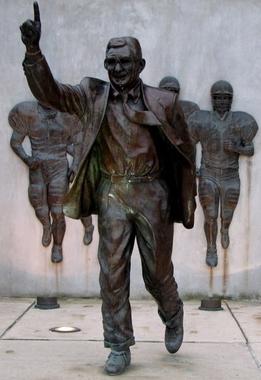
A statue outside Beaver Stadium exemplifies the important impact that Joe Paterno had on Penn State. This is also demonstrated by the rallies held by students on Paterno's lawn the night of his firing as well as the ongoing candlelight vigils being held after his death. Amongst the student body, he was a person to be honored and respected. Amongst his players and former players, he was family. Former player Matt Millen said, "I am numb...Forget the football aspect. We just lost a great contributor to our society. He was more than a football coach...He was a teacher who affected thousands with life-long lessons." Forget football? Ok, that brings us to....

Stage 2: Anger
Paterno's role in the Sandusky sex scandal cannot, should not, and will never be overlooked. Here's what happened: Jerry Sandusky was the assistant coach under Joe Paterno from 1969-1999, 23 years of which he also spent as the team's defensive coordinator. In 1977, Sandusky founded "The Second Mile", a charity to help troubled young boys. In 1998, he was investigated by multiple sources for sexual abuse but no charges were filed. He retried in 1999 but remained at Penn State in an office position for the football team.

In 2008, the mother of a high school freshman boy (Victim 1) reported that her son had been continuously sexually abused by Sandusky since 2005/2006, during which time the boy was involved in The Second Mile and Sandusky was an assistant coach of his school football team.

In December 2010, assistant coach Mike McQueary appeared before the Grand Jury investigating Victim 1's case and stated that, in 2002, he had witnessed Sandusky abusing a different boy, Victim 2, in Penn State's showers. He reported this incident to Joe Paterno. Paterno, in turn, informed athletic director Tim Curley and Gary Schultz, who was overseeing Penn State's police at the time. The two men, along with the school President, Graham Spanier, told Sandusky not to bring children into Penn State facilities. That was the end of the matter for McQueary, Schultz, Curley, Spanier...and Paterno, but not the end for at least 20 boys who would find themselves victims to Sandusky.

Paterno, along with the men he informed, insist that the details McQueary gave to the Grand Jury were not the same information he gave them. It didn't matter to the courts, though. The Grand Jury charged Schultz and Curley with failure to report suspected child abuse. Not facing any legal charges, Paterno announced that he would retire at the end of the 2011 season. The Board of Trustees, though, voted to terminate Paterno's job immediately and unceremoniously fired him in a phone call late one night five days into the scandal.

Stage 3: Bargaining
Two months after he was fired, Paterno attempted to explain the position he found himself in: "I didn't know exactly how to handle it and I was afraid to do something that might jeopardize what the university procedure was...so I backed away and turned it over to some other people, people I thought would have a little more expertise than I did." Paterno didn't face any legal obligations, but he did face some moral ones.

Joe Paterno went to Brown University; he won more games than any other college football coach; he was a smart man. When he says that he didn't know how to handle the situation, I don't believe him. That's an insult to his intelligence and to everyone who heard that statement. When you see someone having a heart attack, you call an ambulance. When you see a bank robbery, you call the police. When you see sexual abuse, you call anyone in any position of power to fix the situation. You could say that he did that by contacting the higher-ups in the school. When they didn't take action, he should have been smart enough to tell someone who would.

Another reason I don't believe Paterno's statement: Sandusky coached beneath Paterno for 31 years. In 1999, when he retired at age 55, he received the Assistant Coach of the Year Award. Why would he retire so young when he was obviously doing such a phenomenal job? Because in 1998, he was accused of sexual assault but no charges were filed. He remained at the school, just not in as an assistant coach. I think they all knew more than they let on, that Sandusky was forced to retire quietly in exchange for the school keeping quiet themselves. Maybe I'm a conspiracy theorist, but it's not the most far-fetched aspect about this whole situation.

Matt Millen said that Paterno was a teacher. A teacher generally guides the younger generation by example and through his wisdom and experience. By this definition, Joe Paterno taught the his students to take the least amount of necessary action as needed to clear your name of any legal obligations. It might be irrelevant, though, because the children that Paterno was supposed to be teaching and guiding were the same children that he allowed Sandusky to abuse. Millen said there is more than football and he was right. Maybe he should have told Joe Paterno that.

Stage 4: Depression
Yesterday on the radio, someone proposed that Joe Paterno died of a broken heart. He died of lung cancer, but the idea is still the same. Paterno had been at Penn State for 62 years. Nittany Lion football was his life and the students and players that he'd met during that time were his family and when he was cruelly (?) but justifiably (?) fired over the phone on the evening of November 9, the Board of Trustees did, in a way, take his life from him. He was sick, his reputation was ruined, his career was over - what else did he have to fight for?

He left behind a wife, five children, seventeen grandchildren, and countless numbers of players and students who loved him as their own family and they are all truly mourning right now. Paterno made inexcusably poor decisions during his lifetime, but dead is dead. His actions don't change the fact that a man died yesterday.

Stage 5: Acceptance
I remember when I first found out that Paterno was involved in the scandal. I've never been a Penn State fan nor a Joe Paterno fan; as I said before, I usually watched his press conference or him with a broken hip on the sidelines and just wondered how he could still do it. But I was stunned and I was sad because, with all the poor role models who are placed in the limelight, it's refreshing to have a person like Joe Paterno, who appears to be the exact opposite and, when the truth came out, it was hard to watch him fall. You can't look at Joe Paterno's accomplishments without looking at his failures, but the opposite can be said as well. Paterno was in imperfect human being whose faults were magnified because he was placed on such a high pedestal by so many for such a long time. He wasn't morally strong, he made bad decisions, he let a lot of bad things happen. He changed a lot of lives, he was loved by a lot of people, and he taught sportsmanship and leadership on the football field. He was human and now he's gone. Joe Paterno was born on December 21, 1926. This is my 26th blog and it is dedicated him. RIP.

Respectfully,
The Sports Nerd

Wednesday, December 28, 2011

Darrelle Revis

The Northwestern Wildcats basketball program has existed since 1901. In 1931 and 1939, they were the regular conference champions. According to the Helms Foundation (which, starting in 1939, was a panel of voters who declared one team a national champion each year based on their record as far back as 1901), they were they were the National Champions in 1931. The NCAA Tournament began in 1939. Since its existence, the Wildcats are the only major conference team to have never appeared in a single tournament game. The Northwestern Wildcats consistently rank among the bottom half of the Big Ten. They've had a total of two finishes above fourth place since World War II and none since 1968. They've played in the NIT six times, including 2009-2011. Last January, Drew Crawford stated that a fan came up to him and said, "You've gotta make the tournament this year." Crawford's response: "Yeah, haven't heard that before."

The strangest thing about Northwestern is that I can never remember them having a really bad team. Let's take a look at their last three seasons, the seasons when they went to the NIT. They've ended each season with winning records and yet still placed 9th, 7th, or 8th, respectively, in the Big Ten. All three years they unexpectedly knocked off at least one top team in the Big Ten (#7 Michigan State, #6 Purdue, and unranked-but-tournament-bound Michigan and Illinois). They have good players: seven players on their current roster are shooting higher than 40%, senior John Shurna, averaging 19.4 ppg and 6.0 rpg, is one of 50 seniors selected John R. Wooden Award and is currently a possibility for the Naismith College Player of the Year Award. The Big Ten has named him one of the top 10 players on the conference. Fellow senior Luka Mirkovic is a 6'11'' center averaging 8.3 ppg and junior Drew Crawford, the team's second highest scorer with 18.1 ppg and 5.0 rpg, scored 34 points in Northwestern's loss to Creighton earlier this week. If star forward Kevin Coble had remained on the team for his senior season last year,  Northwestern more-than-likely would have made the NCAA Tournament last year. But, as has often been the case for the Wildcats, fate intervened and it was simply not meant to be. Their non-conference schedule is always challenging and they perform well enough to leave the season with a winning record overall. So far this season, they're ranked 8th in apg, 89th in ppg, and 93rd field goal percentage. So why doesn't Northwestern make the tournament? Because they're a member of the Big Ten Conference.

The truth of the matter is, if Northwestern played in a different conference, they would have a much greater possibility of making the tournament. The Big Ten is consistently good, sending at least four teams to the tournament a year. Last year, six of the eleven schools (55%) made it. Take a look at the Tennessee Volunteers of the 2010-2011 season. They're members of the SEC, which sent five of their twelve teams (41%) to the tournament last season, and finished conference play 8-8, 19-14 before the tournament started, a .58 winning percentage and in 7th place. They entered the tournament as a #9 seed and lost to Michigan, who Northwestern beat earlier that year. Northwestern, on the other hand, finished conference play 7-11, 18-13 overall before entering the NIT, with a total winning percentage of .58. They placed 8th out of 12. The real difference between the two teams is conference play and it wasn't even that much of a difference. Because of the way the SEC is set up, Northwestern plays more games and therefore has more opportunities to lose and they're playing more teams that will eventually go to the NCAA Tournament themselves. In another conference, a team with Northwestern's record can and does go on to play in March. In the Big Ten, that's harder to do. Northwestern isn't a bad team; they're just always in a bad situation.

If Northwestern wants to make the tournament this year, they can't play average; their 'average' is what it would take for many teams to make the tournament, but not the Wildcats. They're playing in a league that currently has five ranked teams. If they want to make the tournament, the Wildcats can't just pull of one upset this season; they need to finish with a .500 or above record in the conference (to go along with their 10-2 non-conference record) and they need some wins over some ranked teams. The way for them to accomplish that is to finish games; Northwestern has always been an entertaining team to watch because, during the first half of every game they play against a ranked opponent, they stay close and make you think they can win. Then, in the second half, they either fail to make the appropriate adjustments or they run out of energy (or both) and lose. If they can play the second half like they play the first half, they can win. They can start that tonight by pulling an upset at #2 Ohio State.

Earlier this week, the selections for the Pro Bowl were announcers. The Pro Bowl is the all-star game of the NFL, pitting the best of the NFC against the best of the AFC. #24 Darrelle Revis was one of those selected for the AFC defensive team. He plays cornerback for the New York Jets and has made 51 tackles and 4 interceptions this season.

Unhello,
The Sports Nerd

Tuesday, December 27, 2011

Roy Finch

In the 2004-2005 season, the Siena Saints finished 6-24. Fran McCaffery took over the Siena Saints in their 2005-2006 season, a year when they were projected to finish dead last in the MAAC. They also came up with major victories against cross-town rivalry, Albany, and against Niagara on Senior Day. That season their record was 15-13. Then 20-12. In 2009-2010, they set a school record 17 MAAC wins during their 27-7 season. Then McCaffery left and came to coach the Iowa Hawkeyes.

He's only been at Iowa for one season, but it already seems that he might be doing the same thing he did for the Saints to the Hawkeyes. Under Todd Lickliter, the 2009-2010 Hawkeyes finished 10-22, 4-14 in the Big Ten. Last season, they ended 11-20, 4-14 in the Big Ten, 10th place once again. But they also came up with two huge victories during the season - one was a twenty point victory win over Michigan State (which, in retrospect, wasn't as impressive as it might have appeared to be at the time) and a two point home upset over Purdue on Senior Day. These two victories strangely parallel Siena's two most significant victories during McCaffery's first season.

The Hawkeyes have started this season 8-5. They open up Big Ten Conference play Wednesday night at home against Purdue. According to ESPN.com, Iowa ranks higher than Purdue in rebounding, scoring, field goal percentage, and assists per game (all based on their games and opponents so far this season). The last time these two teams met, when Purdue was, in my opinion, a much stronger team, Iowa won. Iowa is stronger this season and Purdue is weaker; this should be a good game and I think Iowa has a good shot at winning. If McCaffery's second season at Iowa imitates his second season at Siena like his first season did, Iowa will improve this year. Admittedly, it's not hard to improve on an 11-20 season and I'm not suggesting that Iowa will be in the running for the Big Ten, but, under McCaffery, that could be a possibility within the next few years. The Saints were projected to finished dead last in the MAAC when McCaffery took over in 2005. By the time he left in 2010, they were coming off their third straight conference championship. Iowa was in a better starting position when McCaffery got them - 2nd to dead last - so who's to say McCaffery won't do the same for them?

Blog #22 is named after Roy Finch, the #22 sophomore running back for the Oklahoma Sooners football team, who has played in all but one game this season. On December 30, the Iowa Hawkeyes football team will play the #14 Oklahoma Sooners in the Insight Bowl. Oklahoma started their season 6-0 before dropping 3 of their last 6 games. They rank in the top 50 for passing yards, rushing yards, points scored, and points allowed (meaning they don't allow a lot). Iowa ranks in the top 50 for points allowed. Iowa is returning to the Insight Bowl for the second straight year and hoping to extend their Bowl winning streak to three against the pre-season #1 team.

I have to go,
The Sports Nerd

Miles Asafo-Adjei

Illinois entered the season unranked, worked their way into the rankings with nine straight wins, and worked their way back out after losing two of their last three games. Their 1-1 against ranked teams (defeating #18 Gonzaga and being defeated by #8 Missouri), and, though they are not ranked in the top 100 nationally for points, field goal percentage, rebounds, or assists according to ESPN.com, Ken Pomeroy has them making the NCAA tournament. Part of the reason they are projected to make the tournament is Sam Maniscalco.

Maniscalco played point guard for the Braves of Bradley University for three years and six games of his senior season, before a persistent ankle injury forced him to have surgery and miss the remainder of his final season at Bradley. After Bradley head coach Jim Les was fired, Maniscalco asked to be released to play elsewhere. Despite interest in both Iowa State and Indiana as well, Maniscalco decided to play as a graduate student for Illinois. The timing could not have been better for the Fighting Illini.

Illinois lost seniors Dimitri McCamey, Mike Tisdale, and Mike Davis, which meant losing 31.7 points out of the average 71.8 the Illini scored a game. The seniors were the leading scorers; the highest returning scorer was then-sophomore Brandon Paul, who averaged 9.2 ppg (which he has increased to 11.3 ppg so far this season). Before gaining Maniscalco, the Illini would have had one senior on the roster, walk-on Jean Selus, who, after joining the team in the 2010-2011 season, had played a grand total of five minutes. What's more, with the graduation of McCamey, the Illini lost their starting point guard. Their other option was true-freshman Tracy Abrams, who is playing 15.2 mpg and scoring 2.4 ppg. While Abrams is a 4-star recruit who's expected to lead the Illini in the future, for the time being he's a freshman who, like any other player, will benefit from playing time and some upperclassmen guidance. At the start of this season, Illinois desperately needed some senior leadership and an experience scorer on the team.

They found this player in Sam Maniscalco. At first glance, Sam Maniscalco appears to be a steady player on the Illinois Fighting Illini basketball team: he's 6'0'' and generously listed as 230 lbs, averages 10.6 ppg, 2.9 apg, and 27.8 minutes a game, and is an 89% free throw shooter. Steady, but not spectacular. But sometimes statistics don't tell the entire story. Maniscalco is the "glue-guy" that the Illini needed. He's not the leading scorer or rebounder, he doesn't play 39 minutes a game, but he fits in with fellow starters D.J. Richardson, Meyers Leonard, and Brandon Paul to create a balanced, well-rounder group of leaders for the Illini and provides the experience and guidance that this team, especially freshman point guard Tracy Abrams, will benefit and learn from.

#22 Miles Asafo-Adjei is a junior guard for the Cornell Big Red. He's averaging a career high 17.9 minutes this season as well as 3.8 ppg. He's from Antioch, TN, and is enrolled in the College of Agriculture and Life Sciences. Cornell is 4-6, but ranked in the top 50 for assists per game. They played both Illinois and Penn State this season and lost to both, by 4 and 7 respectively.

You can go now.
The Sports Nerd

Sunday, December 25, 2011

Jorge Brian Diaz

The Big Ten Conference is the oldest Division I college athletic conference. It was originally called the Intercollegiate Conference of Faculty Representatives and consisted of seven schools: Illinois, Northwestern, Chicago, Minnesota, Wisconsin, Michigan, and Purdue. It became informally known as the Big Nine with the additions of Iowa and Indiana in 1899. Then Ohio State joined in 1912, Chicago left in 1946, and Michigan State joined in 1950. The Conference formally adopted the title the Big Ten in 1987. Penn State was the 11th school in the Big Ten in 1990 and, as of 2011, the Big Ten gained a 12th addition: the Nebraska Cornhuskers.

The Big Ten announced their decision to expand in December 2009. Though no number was set, many analysts speculated that the Big Ten was hoping to expand to 14 or 16 teams in order to increase the influence of the Big Ten Network and to establish a championship game in football (which they did...with disastrous results). Nebraska first petitioned to join the Big Ten in 1900 and then again in 1911 but was denied access both times. On June 11, 2010, they asked, again, for entry and this time they were accepted.

The Cornhuskers were previously members of the Big 12 Conference (ironically, their entrance to Big 10 brought the membership to twelve while their exit from the Big 12 was one of many changes that brought their membership to ten) and, before that, the Big 8 (which gained four new members to become the Big 12). The Big 10 wanted Nebraska for their football program - 5 national titles, 3 Heisman winners, .702 winning record all time - the basketball program just came with them.

Nebraska hasn't won a conference title since sharing the title with Kansas and Kansas State in 1950. They haven't won an outright title is 1916. They've appeared in the NCAA Tournament seven times in school history and are one of three BCS programs to have never won a single NCAA Tournament game (the others being Northwestern and South Florida). Their last March Madness appearance came in 1998, two years after their one and only NIT championship. They've played in the NIT five of the last ten years.

They've started this season 8-3, with losses to Oregon, Wake Forest, and #22 Creighton. According to ESPN.com, they are not in the top 125 nationally for rebounds, points, field goal percentage, or assists per game. According to Ken Pomeroy, they won't be make the NCAA Tournament this year either. Like football, they're first game will be against Wisconsin. Welcome to the Big Ten, Nebraska.

Since most fans of the Big Ten know little to nothing about Nebraska, this blog is titled after #21 on the Nebraska Cornhuskers, Jorge Brian Diaz. Diaz is a junior 6'11'' center from Puerto Rico. He's the teams second leading rebounder (4.9 rpg), scorer (10.9 ppg), and blocker (2.6); coming into this season, he is 10th on the Cornhusker's all time shot blocker list. Last season, the Cornhuskers were 14.3 when he scored in double figures.

Ta ta,
The Sports Nerd